Prototype agents are easy to celebrate because they dodge the hardest deployment questions. The real test arrives when security teams ask about network paths, operations teams ask for monitoring, and product teams ask whether the same agent can work over voice without spawning a second observability stack, which is why the March general-availability release of Foundry Agent Service matters more than a typical platform milestone.
The Responses API Bet Is Strategic
Microsoft has built the next-gen Agent Service on the OpenAI Responses API and emphasizes wire compatibility with existing OpenAI agent patterns rather than inventing a proprietary contract. That is a smart move because it makes migration less about rewriting orchestration logic and more about layering enterprise controls on top of workflows teams may already have in flight.
The March release notes repeat the same message in shorthand: use the same agentic protocol, then gain private networking, Entra RBAC, evaluation, tracing, and multi-model openness on top of it inside the Foundry platform. In other words, Microsoft is trying to compete on production posture, not just on agent syntax.
Private Networking Finally Reaches the Tool Layer
The strongest GA capability is probably not voice. It is end-to-end private networking. Microsoft’s GA announcement says Agent Service now supports bring-your-own virtual network with no public egress and extends that isolation beyond model calls to tool connectivity, including MCP servers, Azure AI Search, and Fabric data agents inside the same network boundary.
That matters because retrieval and tool execution are often where data exposure risk actually lives. The Agent Service overview now lists virtual network isolation, dedicated agent identity, and managed authentication options as core enterprise capabilities rather than optional add-ons. For regulated deployments, that is the difference between an interesting pilot and something a review board might sign off on.
Voice Live Is More Important Than It First Appears
Voice Live is easy to dismiss as a feature for demos, but the design is more interesting than that. Microsoft describes it as a managed speech-to-speech runtime that collapses the traditional STT to LLM to TTS stack into a single API with semantic turn detection, echo cancellation, noise suppression, and barge-in support without forcing teams to stitch three latency domains together.
The key architectural choice is that Voice Live is not a sidecar product. Voice traffic is wired into the same Foundry agent runtime, so prompts, tools, evaluations, traces, and cost visibility remain unified across text and speech instead of splitting voice into a second operational plane. That is exactly the kind of design choice enterprise teams care about once pilots become channels.
GA Evaluations Change the Quality Story
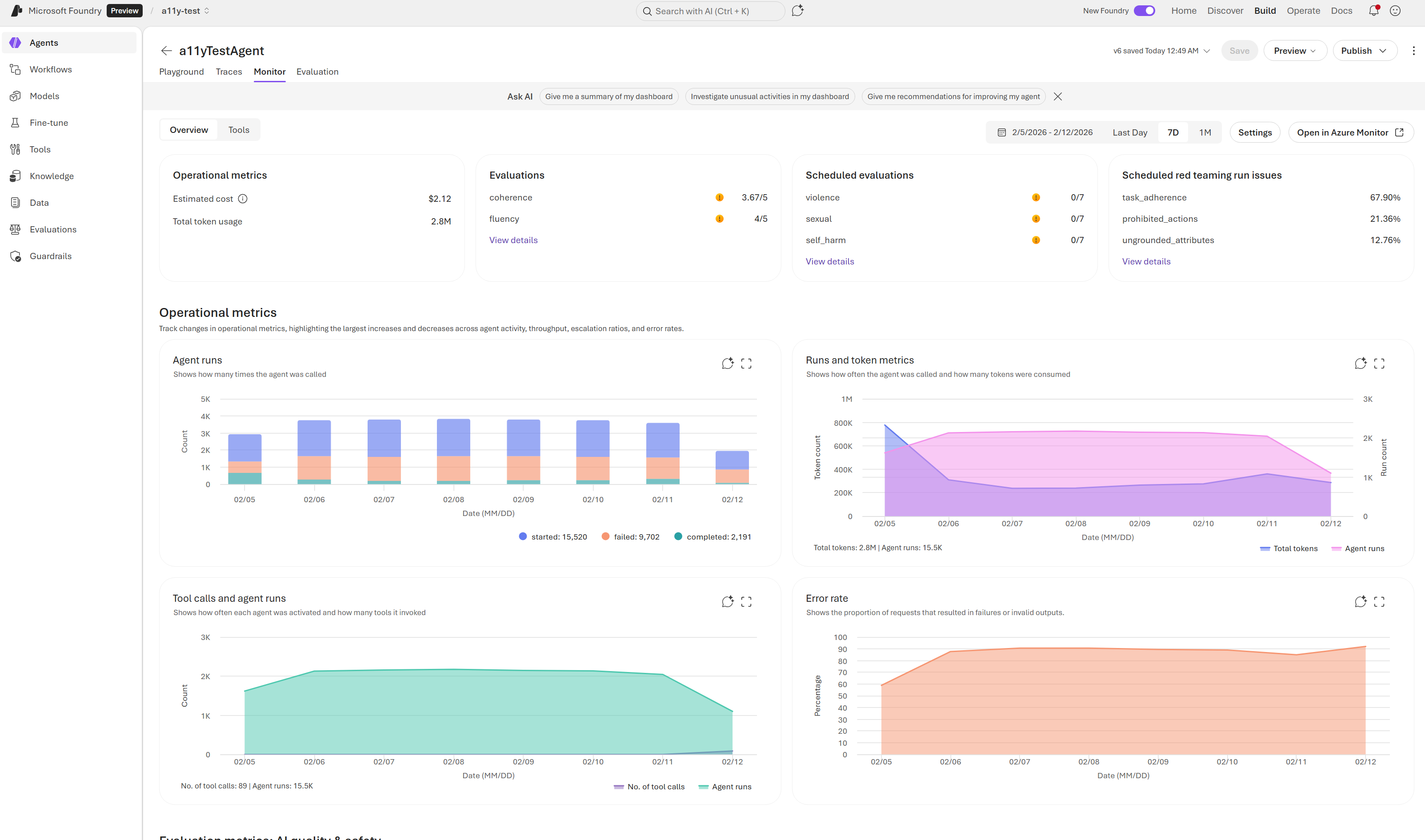
The release also pushes evaluations from pre-launch exercise to production loop. Microsoft says Foundry Evaluations are now generally available with built-in evaluators, custom evaluators, and continuous evaluation that samples live traffic and sends results into Azure Monitor Application Insights for alerting and investigation.
The broader observability docs explain why that matters: Foundry’s monitoring model combines evaluation metrics, tracing, latency, token usage, and red-team signals so quality drift is treated as an ongoing operational signal instead of a one-time test report across the application lifecycle. That is a much more mature quality posture than the usual “we ran a benchmark before launch” story.
GA Does Not Mean Finished
Even with the GA label, some of the most interesting parts of the stack are still staged. The March announcement pairs GA Agent Service with Voice Live preview and hosted agents preview in additional regions rather than full platform finality. That is normal, but it means teams should read “GA” here as the runtime contract becoming dependable, not every adjacent feature becoming production-default overnight.
Still, this release changes the planning conversation. If your team is already building against Responses-style APIs, the migration path into Foundry is now much more about enterprise controls, network isolation, and monitoring than about changing developer mental models. That is a stronger position than many platform vendors manage when they move from preview to production.
Conclusion
Foundry Agent Service GA is important because it addresses the things that usually kill enterprise agent projects after the demo. Private networking, unified monitoring, and a coherent voice path are not flashy compared with new models, but they are what makes agents deployable.
If Microsoft keeps the platform open at the protocol layer while continuing to deepen the control plane, Foundry Agent Service could become the default landing zone for teams that want agent flexibility without owning every production concern themselves.
Chris Wan
Microsoft Certified Trainer (MCT)
Application Architect, SOS Group Limited