
Most organizations believe their AI journey is still in its early stages.
A pilot group is using Copilot. A few departments are experimenting with AI agents. The security team plans to look at governance later.
That’s where many organizations are making a critical mistake.
The assumption is that AI adoption starts when IT officially deploys it.
The reality is that AI agents are often already operating across the organization—accessing data, interacting with systems, and making decisions—long before governance catches up.
The Hidden AI Governance Gap
Most organizations have mature processes for managing employees.
They know:
✅ Who has access to business systems
✅ Who can access sensitive information
✅ How to investigate suspicious activities
✅ How to respond to security incidents
But can they answer the same questions for AI agents?
- How many AI agents are running today?
- Which systems can they access?
- Who owns them?
- Which are actively used?
- Which may already represent a security risk?
For many organizations, the answer is unclear.
And that’s becoming one of the largest governance blind spots in the AI era.
AI Risk Is Already Here
Microsoft’s own Agent 365 demonstrations make this challenge very real.
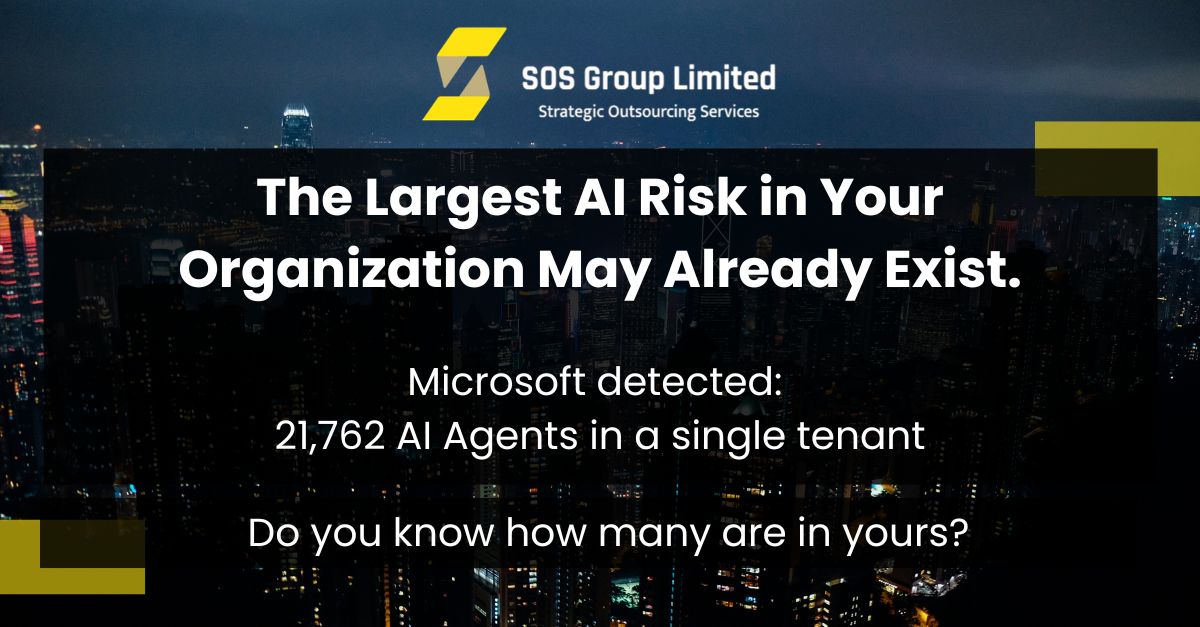
In one tenant scan, more than 21,000 AI agents were identified across the environment. Among them, several had no assigned owner, while others were already flagged as potentially risky due to abnormal sign-in activities and suspicious behaviour.
In another example, shadow AI detection identified a single unmanaged AI application running across more than 1,000 employee devices — without IT approval or governance oversight.
The lesson isn’t that these organizations were careless.
The lesson is that AI adoption is occurring faster than most governance frameworks were designed to handle.
The Wrong Question
Many organizations are asking: “How do we deploy more AI?”
A better question is: “How do we govern AI before it scales beyond our visibility?”
The security and governance challenge isn’t fundamentally different from managing employees.
AI agents have identities.
AI agents access data.
AI agents create risk.
They should be governed accordingly.
The Best Way to Govern AI Agents
Microsoft’s perspective is straightforward:
“The best way to manage agents is to extend the infrastructure you already use to manage users.”
Organizations don’t need an entirely new governance model.
They need to extend existing governance controls to AI agents.
This is why Agent 365 is becoming an important foundation for enterprise AI adoption.
By extending:
- Microsoft Entra for identity governance
- Microsoft Defender for security operations
- Microsoft Purview for compliance and risk management
organizations can manage AI agents using the same principles, policies, and oversight models already applied to employees.
Why This Matters for Microsoft 365 E7
Many organizations are looking at Microsoft 365 E7 as the next evolution of the AI-powered workplace.
What is often overlooked is that governance cannot be a future project.
It needs to be established now.
Agent 365 is currently licensed separately from Microsoft 365 E3 and E5, but it provides the governance foundation organizations will increasingly need as AI adoption accelerates.
Organizations that start building visibility and control today will be significantly better prepared for future AI growth than those waiting for a large-scale governance exercise later.
Is Your Organization Ready?
If your organization is already using Copilot, experimenting with AI agents, or planning broader AI adoption, now is the right time to understand your exposure.
SOS Group is offering a complimentary ME7 Readiness Assessment, including:
✅ Entra identity review
✅ Purview governance review
✅ AI agent exposure assessment
✅ Recommendations for Microsoft 365 E7 readiness
The question is no longer whether AI agents exist in your environment.
The real question is whether you’re governing them.
Book Your Complimentary ME7 Readiness Assessment =click here=
Understand your AI governance posture today and build the foundation for secure AI adoption tomorrow.